You know that sinking feeling when a customer calls to ask where their order is, and your system says it is "out for delivery" but your driver is actually stuck in a three-mile gridlock? It is frustrating for you and even worse for your customer. In the current market, delivery speed is not just a perk. It is the primary way you win or lose. The reality is that the final mile of a product's journey is a financial black hole. It typically accounts for 53% to 60% of your total shipping costs. If you are still relying on manual planning or basic software that doesn't account for real-world chaos, you are likely burning cash. Logistics consulting is the fix that turns your messy delivery routes into a streamlined competitive advantage.
Diagnosis: Where Logistics Consulting Identifies Route Waste
Most businesses think they have a routing problem when they actually have a data problem. You might have great drivers, but if they are working with "average" assumptions, they are set up to fail. A logistics consultant starts by looking at what is actually happening on the pavement, not just what your spreadsheet says should happen.
They look at something called stop-level intelligence. Think of it like this. A standard software package might assume every delivery takes ten minutes. But a consultant knows that delivering to a 40th-floor office in a downtown core takes thirty minutes, while a suburban drop-off takes three. By analyzing historical dwell time and parking availability, consultants build a map that reflects reality.
It is also about identifying constraints that static maps miss. Can your 26-foot box truck actually fit down that narrow alleyway? Does a specific customer only accept deliveries between 10:00 AM and 11:00 AM? Consultants dig into these tiny details to make sure your routes are actually drivable. This is the difference between a theoretical plan and one that actually works when the wheels hit the road.
Implementation: Using Technology for Dynamic Route Optimization
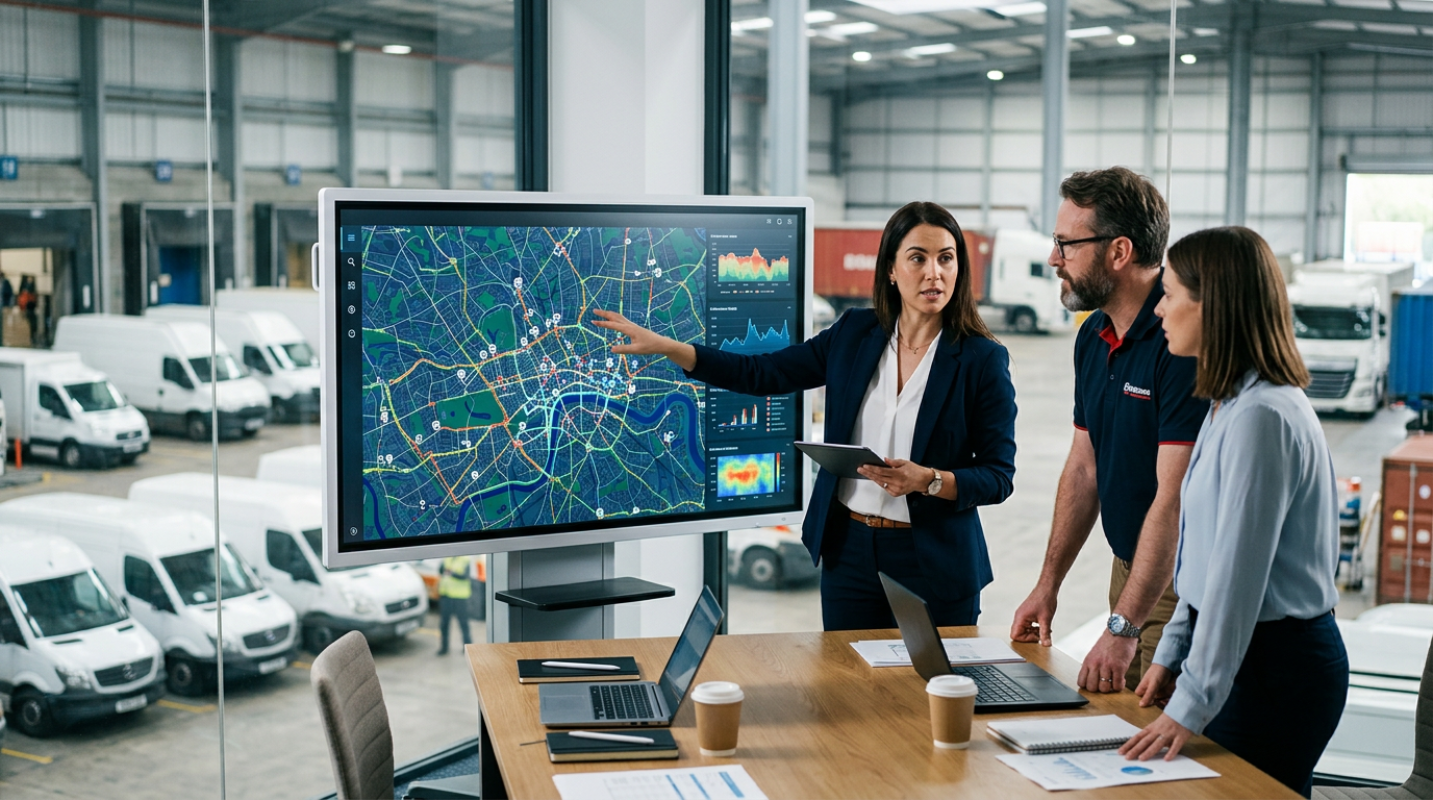
Once the diagnosis is done, the focus shifts to the tech. We have moved far beyond simple GPS points. By 2026, the gold standard is Agentic AI. These are systems that do not just suggest a path. They act as a digital dispatcher that never sleeps.
So what does this actually mean for your daily operations? It means your routes are no longer static. In the past, a driver would leave the warehouse with a printed list and follow it come rain or shine. Today, consultants help you implement "Living Routes" that adjust every fifteen minutes. If a sudden storm rolls in or a major highway is closed, the system automatically reroutes the entire fleet.
This technology also handles the complex math of vehicle utilization. It make sures you aren't sending a half-empty van across town when a fully loaded truck is already nearby. By getting the most from the fill rate of every vehicle, you reduce the total number of trucks on the road. That means less fuel, less maintenance, and fewer hours of driver overtime.
Case Studies in Efficiency Real-World ROI from Optimized Delivery Routes
The numbers behind route optimization are not just theoretical. They are massive. Look at how the big players are doing it. UPS uses a system called ORION that processes 30,000 route optimizations every minute. This isn't just for show. It saves them roughly 10 million gallons of fuel every single year. They have found that saving just one mile per driver per day equals $50 million in annual savings.
Other companies are seeing similar wins
• DHL, Their use of predictive analytics and dynamic routing led to a 12% reduction in total transportation spend across their European networks.
• Tesco, By focusing on stop-level intelligence rather than just distance, they saved 11.2 million miles and cut fuel consumption by 8% per order.
• FedEx, Their orchestration engine improved on-time performance by 20% while cutting the time managers spend on manual planning by nearly half.
For a smaller fleet, these percentages still translate to significant bottom-line growth. If you can increase your daily stops by 20% without adding a single new vehicle, your profit margins look entirely different.
The Long Game: Sustaining Optimization and Future-Proofing Your Network
Optimization is not a one-time event. It is a habit. A good logistics consultant stays with you to set up Key Performance Indicators (KPIs) that actually matter. You should be looking at things like planned versus actual mileage and your success rate for first-time deliveries. If a driver constantly deviates from the AI-suggested route, the consultant helps you figure out why. Is the AI wrong, or does the driver need better training?
We are also seeing a massive shift toward Electric Vehicles (EVs) and urban micro-fulfillment centers. Transitioning to an electric fleet adds a new layer of complexity. You have to factor in battery discharge rates, payload weight, and where the charging stations are located. AI-driven routing is the only way to manage these variables effectively.
Finally, think about the "human-in-the-loop" factor. Drivers often distrust a computer telling them where to go. Consultants help bridge that gap by using explainable AI. Instead of just giving a direction, the system tells the driver why, such as "Avoiding school zone traffic at 3:00 PM." When your team understands the logic, they are much more likely to follow the plan.
In the end, logistics consulting is about making sure your delivery network is as agile as the market demands. It is the digital equivalent of clearing the road so your business can run at full speed.