Have you ever walked into your office on a Monday morning and felt like the air was just... heavy? It’s that unmistakable sensation of stale, recycled atmosphere that makes you want to crack a window, even when it’s freezing outside. We spend roughly one third of our lives at work, yet most of us give more thought to the ergonomics of our chairs than the quality of the air we’re breathing. It’s time to change that. As we move through 2026, the conversation around the workplace has shifted. It’s no longer just about where you work, but the biological safety of the space you’re in. Clean air isn't a luxury or a "nice to have" perk anymore. It’s a fundamental part of a high performing office.
The Invisible Threat and Why Office Air Quality Demands Attention
Think of your office air as a soup. You can’t see the ingredients, but they’re definitely there. We’re talking about Volatile Organic Compounds (VOCs) off-gassing from that new desk, microscopic dust mites in the carpet, and the lingering remnants of someone’s tuna sandwich from three days ago.
Then there are the invisible guests we’d all rather avoid, like viruses and bacteria. When someone sneezes in an open plan office, those particles don't just vanish. They hang around, hitching a ride on air currents and settling on your keyboard.
So what does this actually mean for you? Poor indoor air quality (IAQ) is a silent productivity killer. Have you ever felt that mid afternoon brain fog that no amount of caffeine can fix? It might not be your sleep schedule. It could be rising CO2 levels or a buildup of pollutants. Studies show that poor air leads to more sick days and a general "blah" feeling that keeps your team from doing their best work. It’s hard to focus on a complex spreadsheet when your lungs are filtering out office dust all day.
Beyond the Filter and How Modern Air Purifiers Revolutionize the Workplace
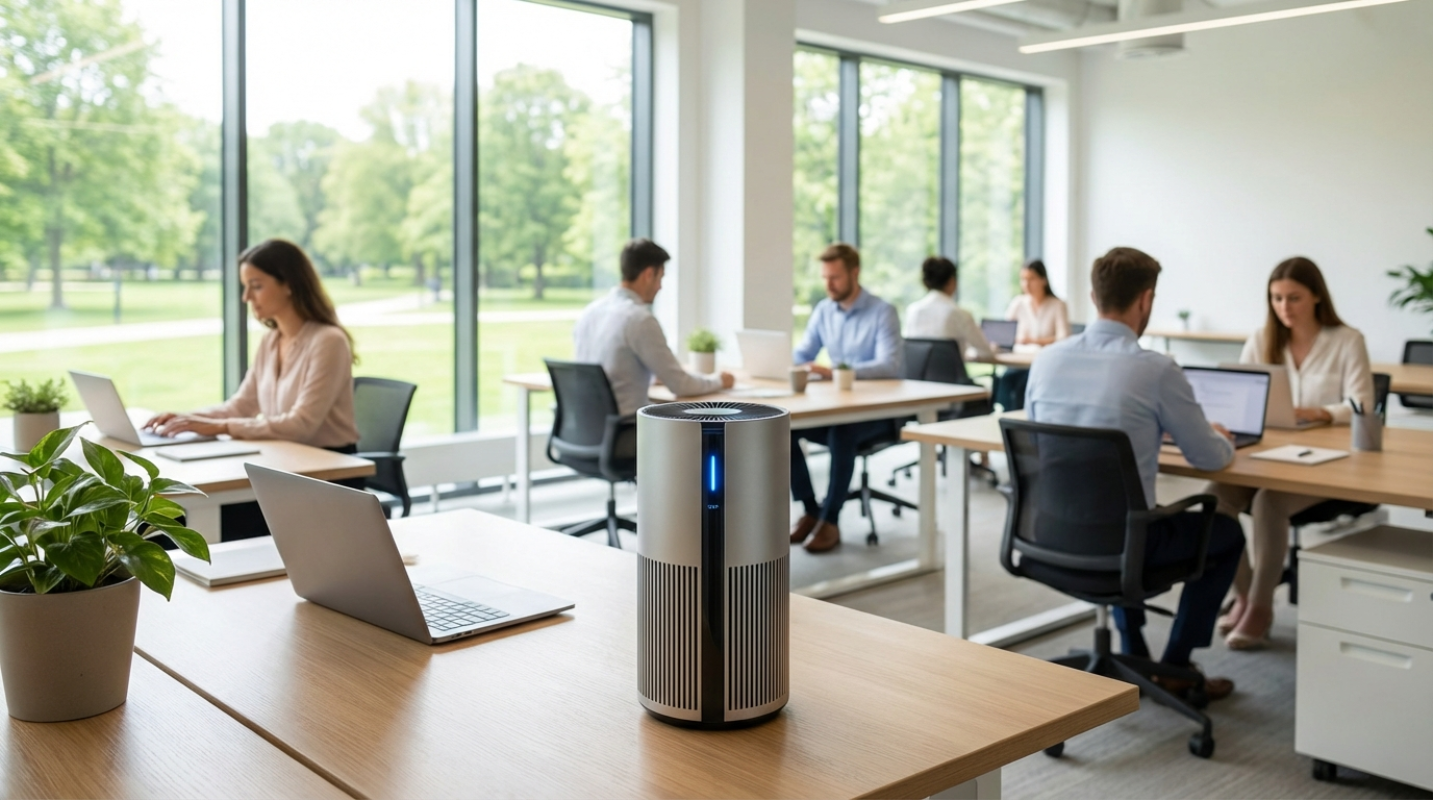
When most people think of air purifiers, they picture a noisy box in the corner that doesn't seem to do much. But the tech has come a long way. Modern units are sophisticated machines designed to scrub the air with surgical precision.
The heavy lifters here are HEPA filters. By 2026 standards, H13 or H14 HEPA is the baseline for any serious office. These filters are incredibly dense. An H13 filter catches 99.95% of particles as small as 0.2 microns, while the medical grade H14 pushes that to 99.995%. To put that in perspective, a human hair is about 50 to 70 microns wide. These machines are catching things you can’t even imagine.
But it’s not just about trapping dust. Activated carbon filters are the secret weapon against smells and chemicals. They act like a chemical sponge, soaking up VOCs and odors that a standard filter would miss. This matters for offices near busy roads or those with industrial printers.
We’ve also seen a massive rise in smart monitoring. In 2026, you shouldn't have to guess if your air is clean. Modern purifiers come with sensors that tell you exactly what’s happening in real time. They can detect a spike in particles (maybe from someone’s perfume or a nearby construction site) and ramp up their power automatically. It’s the digital equivalent of having a full time janitor for your atmosphere.
Choosing the Right Machine for Different Work Spaces
You wouldn't use a desk lamp to light up a warehouse, and the same logic applies to air purifiers. You need to match the machine to the room. The metric you need to know is Clean Air Delivery Rate (CADR). This tells you how much filtered air the unit can pump out in a minute.
For a large open plan office, you need a high CADR and a high number of Air Changes per Hour (ACH). The current gold standard is 4 to 6 air changes every hour. If you’re just circulating the air once or twice, you’re not really cleaning it.
Noise is the other big factor. No one wants to work next to something that sounds like a jet engine taking off. The best commercial units today manage to move a massive amount of air while staying whisper quiet.
Top Recommendations for 2026 Workspaces
• Dyson Big+Quiet (BP03/04), This is the king of the open office. It’s designed to project air over 32 feet, making sure the person in the far corner gets clean air too. It’s also incredibly quiet, even when it’s working hard.
• IQAir HealthPro Plus, If you’re in a high density area or a medical setting, this is the one. Its HyperHEPA filtration captures particles down to 0.003 microns. That’s smaller than most viruses.
• AeraMax Pro AM 3/4, These are great for shared spaces like breakrooms. They have a "PureView" screen that shows real time particle counts, which is a great way to show employees that you’re actually taking their health seriously.
• Blueair Blue Pure 211i Max, A fantastic choice for medium sized offices. It can clean over 3,000 square feet in an hour using HEPASilent tech, which combines mechanical and electrostatic filtration.
• Coway Airmega 400S, Perfect for tech forward offices. It has a dual suction design that pulls in air from two sides at once, making it very efficient for its size.
The ROI of Clean Air and the Business Case for Purifiers
Let’s talk money. If you’re a business owner or a manager, you might be looking at the price tag of a commercial grade purifier and wondering if it’s worth it. The data says yes, and it’s not even close.
Investing in air quality is a performance driver. Recent research highlights that improved IAQ correlates with productivity gains of 8% to 11% in office environments. Think about that for a second. If your team is 10% more productive because they aren't sluggish and foggy headed, the machines pay for themselves in weeks.
There’s also a famous study from Harvard and Syracuse that found employees in high ventilation, low VOC environments performed 61% better on cognitive tests. It turns out that when you aren't breathing in "office soup," your brain actually works the way it’s supposed to.
Then there’s the "40 to 6,500" ratio. Some studies suggest that spending just $40 per person per year on high quality air purification can result in a $6,500 increase in annual productivity per employee.³That is a massive return on investment.
Beyond the raw numbers, there’s the human element. Providing clean air shows your team that you care about their well being. In a competitive job market, that kind of focus on health helps with retention and morale. People want to work in places that don't make them feel sick.
This article on rotechno.com is for informational and educational purposes only. Readers are encouraged to consult qualified professionals and verify details with official sources before making decisions. This content does not constitute professional advice.